
Cannabis Killed How Many Kids?
Cannabis Killed How Many Kids?
The Gummy Gets a Headline. The Liquor Cabinet Gets a Pass.
Cannabis poisoning in children makes frightening headlines, but how many children has cannabis actually killed compared with alcohol?
A toddler eats a THC gummy, and cannabis gets the headline.
A teenager raids the liquor cabinet, drinks until they black out, lands in the emergency room, or dies from alcohol poisoning, and somehow alcohol itself escapes the interrogation.
Why?
The rise in accidental cannabis exposure among young children is real. It should be taken seriously. Cannabis products belong locked away from children, period.
But if we’re going to talk about protecting kids, then let’s talk about all the numbers.
Let’s compare cannabis with alcohol. Let’s distinguish exposures from hospitalizations and hospitalizations from deaths. And let’s ask the uncomfortable question:
Is cannabis being judged by the same standard as the bottle sitting openly in millions of American homes?
Because the liquor cabinet keeps getting a pass.
The gummy keeps getting the headline.
The Headlines Are Real. But Are They Telling the Whole Story?
Let’s start with the facts.
A major study published in Pediatrics examined reported edible cannabis exposures among children younger than six years old in the United States between 2017 and 2021.
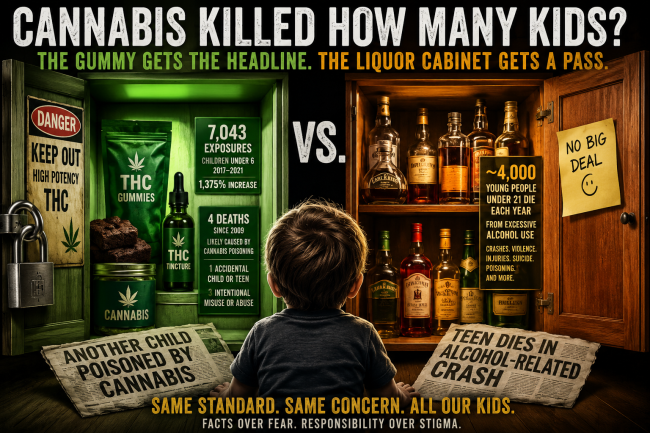
Researchers identified 7,043 reported exposures during those five years.
In 2017, there were 207 reported cases.
By 2021, that number had risen to 3,054.
That’s an increase of approximately 1,375%.
Yes, that’s dramatic.
And yes, it deserves attention.
About 22.7% of those children were admitted to the hospital. The children most commonly affected were two- and three-year-olds.
Those numbers should not be dismissed or minimized. A two-year-old doesn’t understand the difference between a THC gummy and ordinary candy. A brownie is a brownie. A cookie is a cookie. Chocolate is chocolate.
Adults know the difference.
Children don’t.
Cannabis products should be stored securely where children cannot reach them. So should alcohol, prescription medications, nicotine products, household cleaners, and anything else capable of poisoning a child.
But there’s something else we need to understand.
An exposure is not automatically a poisoning.
A poisoning is not automatically a hospitalization.
A hospitalization is not a death.
Those words matter.
And when those distinctions disappear from a headline, the public may walk away with a very different understanding of what actually happened.
Poisoning Does Not Automatically Mean Death
The word “poisoning” is powerful.
When most people hear that a child was poisoned, they imagine the worst possible outcome.
But poison-center data can include reported or suspected exposures with widely varying results.
One child may become sleepy and be monitored.
Another may be taken to an emergency room for observation.
A more seriously affected child may experience breathing problems, seizures, coma, or require intensive care and mechanical ventilation.
Those are serious outcomes. They should never be brushed aside.
But neither should they all be treated as the same thing.
If we’re going to have an honest conversation about cannabis poisoning in children, we need to be precise about what the statistics actually measure.
Because thousands of reported exposures do not mean thousands of deaths.
Not even close.
So, How Many Children Has Cannabis Actually Killed?
This is where the numbers get interesting.
According to information reported by The New York Times and republished by the American College of Medical Toxicology, America’s Poison Centers judged four deaths since 2009 as likely caused by cannabis poisoning.
Four deaths.
Of those four, only one involved a child or teenager and was accidental. The other three involved intentional misuse or abuse.
The available information does not reveal the exact age of the young person who died, so we cannot honestly claim that cannabis has killed no children under six. We don’t know the age from the available data.
And that’s important.
We’re not going to twist statistics to make cannabis look better.
We’re going to tell the truth.
Children have become seriously ill from cannabis. Some have experienced seizures, breathing problems, coma, and intensive-care hospitalization. More than 100 patients among the cases examined by The New York Times required ventilators.
Those risks are real.
But so is this fact:
Since 2009, America’s Poison Centers judged four deaths across all age groups as likely caused by cannabis poisoning.
Only one involved a child or teen and was accidental.
Now let’s open the liquor cabinet.
Alcohol Is Familiar. That Doesn’t Make It Harmless.
According to the Centers for Disease Control and Prevention, approximately 4,000 people under age 21 die from excessive alcohol use every year in the United States.
Every year.
Now, let’s be fair about that number.
It does not mean 4,000 toddlers die each year from sneaking into their parents’ liquor cabinets. It does not mean 4,000 young people die specifically from acute alcohol poisoning.
The figure includes deaths from motor-vehicle crashes, violence, other injuries, suicide, alcohol poisoning, and other consequences associated with excessive alcohol use.
We’re not going to compare statistics that measure different things and pretend they’re identical.
But we should still ask the question:
If we’re genuinely concerned about intoxicating substances harming America’s children and young people, why does cannabis so often seem to stand alone in the interrogation room?
Why does a cannabis gummy become evidence of a dangerous substance, a dangerous industry, or failed legalization?
Yet when alcohol contributes to thousands of deaths among young people every year, the bottle itself somehow slips quietly out of the courtroom.
The Bottle Is Familiar. The Gummy Is Suspicious.
Alcohol has had generations to become part of the wallpaper.
It’s at weddings.
Christmas dinners.
Football games.
Restaurants.
Backyard barbecues.
Birthday parties.
Retirement celebrations.
Nobody gasps when Grandma has a glass of wine with dinner.
Nobody calls Dad an addict because he keeps a bottle of bourbon in the kitchen cabinet.
We don’t call liquor stores “alcohol dispensaries.”
Alcohol is familiar.
Cannabis is still fighting nearly a century of stigma.
For decades, cannabis was portrayed as dangerous, criminal, immoral, and socially destructive. It was blamed for violence, insanity, moral decay, and the corruption of young people.
Those messages didn’t simply disappear when states began legalizing cannabis.
The laws changed faster than the culture.
The stigma stuck around.
And it still affects how cannabis stories are told.
What Happens When a Toddler Eats a Gummy?
Let’s be clear.
A toddler accidentally consuming a high-dose cannabis edible can be a genuine medical emergency.
Children are smaller than adults. Their bodies can be far more sensitive to THC. A dose that an experienced adult consumer might tolerate can have a dramatically different effect on a two-year-old.
Young children who consume THC may become extremely sleepy, confused, unsteady, or difficult to wake.
Some experience vomiting, breathing problems, seizures, or coma.
Some require hospitalization.
Some require intensive care.
Some have needed ventilators.
That’s not propaganda.
That’s not Reefer Madness.
That’s medicine.
Cannabis products should be kept locked away from children.
- And so should alcohol.
- So should prescription medications.
- So should nicotine products.
- So should household chemicals.
Responsible cannabis advocacy doesn’t require pretending cannabis is harmless.
It requires demanding that cannabis be judged honestly and by the same standards we apply to other substances.
Is Cannabis More Dangerous, or Just More Visible?
Legalization has changed the landscape.
More cannabis products are available. More adults are consuming them. More homes contain them.
That naturally creates more opportunities for accidental exposure.
Edibles present a particular challenge because they can resemble ordinary foods that children already recognize and enjoy.
A gummy looks like candy.
A cannabis brownie looks like a brownie.
A THC-infused chocolate bar looks like a regular chocolate bar.
A young child doesn’t read the label, check the THC content, or understand a warning symbol.
That’s why child-resistant packaging and secure storage matter.
But there’s another part of the story worth considering.
Legalization may also make people more willing to report cannabis exposure.
Years ago, a parent or caregiver might have been afraid to tell a doctor, emergency-room nurse, or poison-control specialist that cannabis was involved.
They might have feared arrest, losing custody of a child, or other legal consequences.
In a legal market, people may be more willing to tell medical professionals what actually happened.
So when reported cases increase, shouldn’t we ask more than one question?
Are more children being exposed?
Are more cannabis products available?
Are people more willing to report exposures?
Or are all three happening at once?
The answer may be complicated.
Headlines rarely are.
Why Does the Product Get Blamed?
Here’s where the double standard becomes hard to ignore.
A teenager drinks too much, and we blame teenage recklessness.
A drunk driver kills someone, and we blame the driver.
A child gets into a liquor cabinet, and we blame the adult who left it accessible.
But when a toddler eats a cannabis gummy, the product itself often becomes the defendant.
Why?
Why isn’t the first question about the adult who failed to secure it?
Why isn’t the conversation about responsible storage?
Why does one incident so easily become an indictment of cannabis itself?
Imagine if we applied that same standard to every other potentially dangerous product found in American homes.
A child swallows a prescription medication. Ban the pharmaceutical company?
A child drinks vodka. Blame the distillery?
A child consumes a nicotine product. Condemn every adult who uses nicotine?
Of course not.
We look at what happened.
We look at how the child gained access.
We talk about adult responsibility, safer packaging, education, and prevention.
Cannabis deserves that same level of reason.
Not a free pass.
A fair one.
What About Teenagers?
There’s another important distinction we need to make.
A two-year-old accidentally eating a THC gummy is not the same public-health issue as a 17-year-old deliberately drinking alcohol or using cannabis.
Toddlers don’t make informed choices about intoxicants.
Teenagers sometimes do.
And teenagers have been sneaking alcohol from their parents’ liquor cabinets for generations.
They’ve also found ways to get cannabis.
Pretending otherwise doesn’t protect anyone.
The real question is whether we’re giving young people accurate information about both substances or simply repeating old warnings about one while culturally accepting the other.
Alcohol can cause fatal poisoning.
It can contribute to car crashes, violence, injuries, suicide, and other devastating consequences.
Cannabis carries risks too, particularly for young people whose brains are still developing. Heavy or frequent use may affect memory, learning, attention, and mental health, especially in vulnerable individuals.
Both conversations matter.
But they should be based on evidence.
Not stigma.
Cannabis Doesn’t Need a Free Pass. It Needs a Fair One.
I’m not asking anyone to ignore accidental cannabis poisoning.
I’m not asking parents to leave gummies on the coffee table.
I’m not claiming cannabis is harmless.
I’m asking for consistency.
If a cannabis product is left where a toddler can reach it, hold the adult responsible for unsafe storage.
If packaging is designed in a way that dangerously appeals to children, hold the company responsible.
If regulations can improve child safety without relying on fear or misinformation, improve them.
But don’t turn every accidental exposure into evidence that cannabis itself is uniquely dangerous while ignoring the whiskey bottle sitting three feet away.
Cannabis doesn’t need a free pass.
It needs a fair one.
Maybe It’s Time to Blame the Unlocked Cabinet
Cannabis does not belong in the hands of children.
Neither does alcohol.
Neither do prescription drugs, nicotine products, household chemicals, or anything else capable of causing poisoning.
Adults are responsible for storing ALL intoxicating products securely.
Cannabis companies have a responsibility to use responsible packaging.
Regulators have a responsibility to create sensible rules based on evidence rather than fear.
But the media has a responsibility, too.
If we’re going to talk about children and cannabis, then let’s talk about the whole story.
Let’s distinguish an exposure from a hospitalization and a hospitalization from a death.
Let’s acknowledge the genuine rise in accidental edible ingestion without pretending cannabis suddenly invented childhood poisoning.
Let’s stop using the word “poisoning” as though every exposure had the same outcome.
Let’s tell parents the truth about the risks.
Let’s demand responsible storage.
Let’s demand responsible packaging.
But let’s also ask why one substance is still forced to carry nearly a century of cultural baggage while another, responsible for thousands of deaths among young people every year, sits comfortably in the kitchen cabinet.
The gummy gets dragged into the spotlight.
The liquor cabinet sits quietly in the corner, polished, familiar, and somehow above suspicion.
The gummy gets the headline.
The liquor cabinet gets a pass.
Maybe it’s time we started asking why.
Sources and Further Reading
Pediatric Edible Cannabis Exposures and Acute Toxicity: 2017–2021
Marit S. Tweet, MD; Antonia Nemanich, MD; Michael Wahl, MD. Pediatrics. 2023;151(2).
This study examined 7,043 reported edible cannabis exposures among children younger than six years old in the United States between 2017 and 2021 and documented a 1,375% increase during that period.
DOI: https://doi.org/10.1542/peds.2022-057761
American Academy of Pediatrics: https://publications.aap.org/pediatrics/article/151/2/e2022057761/190427/Pediatric-Edible-Cannabis-Exposures-and-Acute
Centers for Disease Control and Prevention: Underage Drinking
The CDC reports that about 4,000 young people under age 21 die from excessive alcohol use each year in the United States. The figure includes deaths associated with motor-vehicle crashes, violence, other injuries, suicide, alcohol poisoning, and other causes.
https://www.cdc.gov/alcohol/underage-drinking/index.html
American College of Medical Toxicology: Cannabis Poisonings Are Rising, Mostly Among Kids
The American College of Medical Toxicology republished selected excerpts from a New York Times investigation into rising cannabis poisonings. According to the excerpts, America’s Poison Centers judged four deaths since 2009 as likely caused by cannabis poisoning. One involved a child or teenager and was accidental; the other deaths involved intentional misuse or abuse.
Source: The New York Times, August 10, 2025. Medical toxicologists featured: Robert Hendrickson, MD, FACMT, and Laurén Murphy, MD.
Do you want GrammaWeed to come speak to your group? Or do you want more information? Contact GrammaWeed, aka Cynthia Saarie, at BestCopyNow.com.
My Commitment to Responsible Advocacy: GrammaWeed (Cynthia Saarie)
I am a cannabis advocate, but I am not an advocate for irresponsible cannabis use.
Children should never have access to cannabis products. Edibles should be securely stored, clearly labeled, and kept out of children’s reach. Parents, caregivers, cannabis companies, and regulators all have a responsibility to protect children.
But advocacy also means challenging misinformation, stigma, and double standards.
This article is not an attempt to minimize the genuine risks of pediatric cannabis exposure. It is a call for honesty, context, and consistency. If we are going to talk about the dangers of cannabis to children and young people, then we should be willing to examine other intoxicating substances with the same scrutiny.
Cannabis doesn’t need a free pass.
It needs a fair one.
Cynthia Saarie
GrammaWeed | Budz Up?